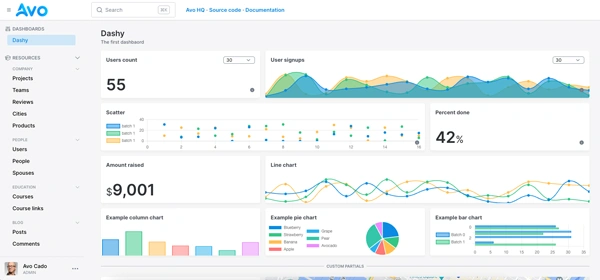











Motor Admin Alternative: is Avo the right choice for me?
Yes, we're biased. We build Avo everyday with the goal to be the best admin framework for Rails apps and we're not ashamed about that.
We also think that Motor Admin is a very valid alternative to build an admin panel using Rails.
Avo and Motor Admin are built with the goal of avoiding the repetitive tasks that are needed to build any admin panel or internal tooling: CRUD, view creation, filtering, searching, all the usual boring stuff.
However, there are some differences that might help you decide which option is best for you. Let's explore them:
The experience of building a no-code or low-code admin panel
Building things without resorting to code is a very ambitious premise and it's been one of the most sought after features of software since the very beginnings of the industry.
After all, a programmer's job is to translate requirements into what a computer can understand and execute.
Developments like SQL, the database querying language that powers most of dynamic applications nowadays, or Visual Basic, were built with the goal of replacing previously existing programming languages with a new language that managers or stakeholders could write without knowing the intricacies of how computers work.
The same can be said about newer developments like some CMSs or no-code/low-code tools like Zapier or Airtable.
For such an ambitious promise, these tools have delivered some mixed results through the years:
- They failed to achieve their original goal but made things better for everybody: even if the goal of getting rid of programmers was tried a bunch of times but never fully achieved, these tools reached the goal of lowering the bar for newcomers and old-timers equally.
- We can build awesome stuff without needing to code: think about building a website with content management in the 90's vs doing the same thing with tools like Webflow or Wordpress. The same thing can be said about other no-code/low-code platforms that allow us to build products like mobile apps or data backed applications even if we're not programmers.
- No-code means some-code: until now, no-code tools have made software capable of generating software. However, the fact that software is still being generated to talk to computers (that still speak the same language as 50 years ago) proves that some coding is needed along the way. Even though we're getting closer, handling the ever growing complexity of software is not yet doable without writing code at some point of the journey.
When it comes to internal tools or admin panels, aiming to build them without writing code is achievable but it comes with the same frictions and disadvantages that every piece of no-code/low-code software has.
In this regard Motor Admin has both an advantage and a disadvantage: you can write admin panels with minimal coding intervention but if you end up needing to customize something along the way you will need to resort to a developer or learn how to do it yourself.
The pros and cons of Motor Admin
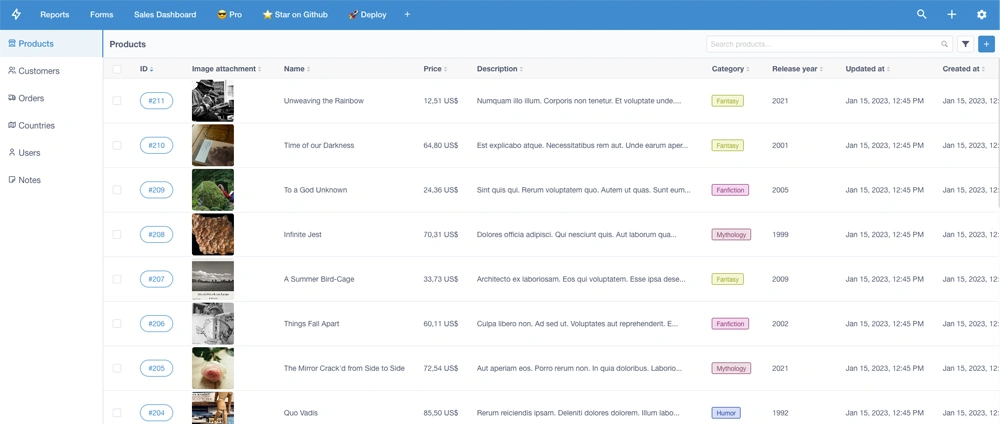
Motor Admin brings a breath of fresh air to the Rails admin ecosystem.
It has a very different approach compared to previous solutions that laid the foundation but now feel outdated. That's why we welcome Motor Admin as a competitor, as it elevates the entire ecosystem.
So here are the benefits and downsides we consider for Motor Admin:
-
Build an admin panel with little to no code: Motor Admin allows you to build internal tooling using little to no-code. The Motor Admin Rails gem is designed to build an admin panel around the models you already have or you add to your application. Configuration is handled entirely from the UI. This has the advantage to allow non technical people to build internal tooling around Rails code without even knowing there's code.
-
Build with a stack other than Rails: in case you don't use Rails or are not interested in using it, Motor Admin allows you to hook your admin panel to a database (MySQL, Postgres, SQL Server) and use any stack you want to use on top of the database. Beyond Rails, you can use Node, PHP, Go, Spring Boot, Phoenix, .NET and Rails. It also allows you to use a self-hosted/managed Postgres services like Supabase which gives you extra features like authentication, real time updates and battle tested scaling.
-
A nice feature set that allows you to build faster: Motor Admin has a variety of features that can accelerate the development process when you're starting out from a Rails codebase. You can actually use it's UI to build the views for your resources, filter and search data. It also allows you to add dashboards, forms and queries to help you navigate the needs of your internal tooling.
-
Ability to create reports and data visualizations from the UI: it gives you the ability to define and store queries using SQL which can be made into dashboards to facilitate data visualization via charts.
-
Thin documentation: Motor Admin leans on its in-UI configuration rather than a deep written reference, so its docs stay light. When you do need to look something up or push past the defaults, there is not much to go on. Avo, by contrast, ships an extensive, searchable documentation site that covers every field, view, and add-on and grows with each release.
-
Built as an SPA using Vue.js: Motor Admin uses Vue.js for the frontend and Rails for the backend. It's a perfectly valid stack, but it sits off the Rails golden path, so the moment you need to customize beyond what the UI exposes you're writing Vue instead of the Rails you already know. If you're already building a Vue SPA on a Rails backend, that's less of a hurdle.
-
Low release cadence: Motor Admin is still maintained. After a long quiet stretch it picked back up, shipping releases through 2025 and 0.5.0 in February 2026. That said, it moves at a handful of releases a year, so fixes and new capabilities land slowly, and keeping pace with each new Rails version is not guaranteed the way it is with a fast-moving project.
What makes Avo the right choice for your next application
Avo and Motor Admin can make you more productive than you would be without an admin framework.
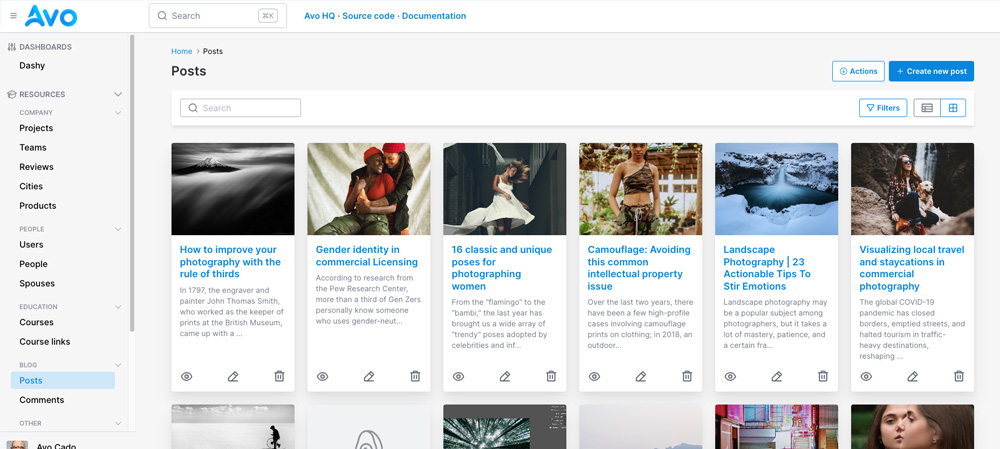
However, Avo is easily customizable, which is an advantage over Motor Admin when it comes to keeping that productivity in the long term.
Yet, the main fact that makes Avo a better alternative to Motor Admin is that it's actively improved each and supported by a community of free and paying users that push Avo's development further each and every day.
Let's see what makes Avo a great choice when it comes to building internal tooling or admin panels using Rails:
-
A wealth of fields: Avo comes with more than 30 fields out of the box. They allow you to meet the needs of most Rails apps without resorting to customization. You're covered if you need: text, WYSIWYG editors, password, money, number, boolean, progress, datetime, select, taglist, key value pair, file upload, and others.
-
Easily customizable: Avo is designed so you never hit a wall. When you need something the defaults don't cover, you reach for an "escape hatch" and replace just that piece with plain Rails: swap a view, partial, field, or component, point a scope at a model scope you already trust, or drop down to your own code. You extend Avo instead of fighting it, which is exactly where a low-code tool tends to run out of room.
-
The features Motor Admin sells, as add-ons: The dashboards, forms, and BI-style tooling Motor Admin bundles into its core and Pro tiers all have direct, Ruby-native answers in Avo's add-on catalog: Dashboards for real-time metrics, Forms and Reactive Fields for custom and smart forms, and Authorization for the roles and permissions Motor Admin puts behind its Pro plan. You add only the ones you need, and each stays plain Rails underneath.
-
Built with the tools you already know: Avo is built using tools that most Rails developer use on their day to day. That means that you can get up to speed very quickly and be productive with Avo even if you've never used it before.
-
Great documentation: Hunting for answers is a time drag, so every Avo feature is documented in our docs. The documentation is searchable, indexed by search engines, and referenced in our release videos whenever it's relevant. We document every change we ship so you spend your time building, not reverse-engineering the framework.
-
Constantly improved: Avo ships far more often than Motor Admin, many releases to their handful in a year. Even on the free Community tier, that means the framework is actively maintained and keeps getting better, and it keeps pace with new Rails versions as they land. With 250+ paying companies and a large base of free users behind it, Avo is a safe long-term bet.
-
Some code is required to build with Avo Right now, Avo requires you to have some knowledge of Ruby on Rails to build with it. You can start with nothing but the basics to build products and learn along the way while being insanely productive from the get go. Of course, you can also make use of Avo if you're an advanced Rails developer by avoiding to write the same ol' CRUD interface again and saving time in the process.
-
Avo is currently a Rails only solution Avo is a Ruby gem that works for Rails projects. So that means that you can't hook it directly to a database or use a different tech stack to build your product.
So, should I choose Avo or Motor Admin?
Well, as with a lot of stuff, it depends: you can choose either of them and get a satisfactory experience, at least when starting out.
If you're not technical or you're reluctant to handle code you should probably choose Motor Admin you can build an quickly build an admin panel and enjoy the features it gives you.
You should also consider the tech stack when making the decision: if you don't really care about Rails or the Rails way you can consider Motor Admin as an alternative. However, if you're a Rails developer or comfortable writing Rails code, Avo is probably the better choice for you.
Contemplate that the no-code/low-code premise can be hard to accomplish in the long term. If you're aware that you will need a developer to help you with your needs you can safely go the Motor Admin route.
Also, even though Motor Admin can help you build a project without using much code, there are probably more beginner friendly alternatives in the market that can abstract you even further away from code: Airtable, Bubble, among others.
Having said this, you should also consider that Avo is an actively maintained library, so you won't be on your own down the road if you pick it to build internal tooling or admin panels.
Motor Admin is still around and shipping the occasional release, but it moves slowly, at a handful of releases a year. Avo ships far more often, which matters when you need a bug fixed or want the tool to keep pace with the latest Rails.
The elephant in the room: why is Avo a paid product?
You're probably wondering why would anyone pay for an admin framework like Avo if there are other alternatives like Active Admin, Rails Admin or Administrate right?
For starters, our free Community tier takes you a long way when building internal tools or admin panels, and we keep adding to it. You can build a real, working admin on it without paying a cent.
The fact that Avo has paid plans is also the point: it's what lets us keep improving Avo every day, adding the features customers ask for and fixing issues fast, instead of the project quietly going idle.
Paying for an admin framework can feel unnecessary when you're starting out and time feels free. You can probably build it in a weekend, right? It's rarely that simple. The real cost isn't the first version, it's the years of edge cases, security, and upkeep you own afterward. Avo's paid plans absorb that for a small fraction of what a senior developer's time would cost.
Motor Admin also offers paid Pro and Pro Enterprise plans that unlock white-labeling, advanced roles and permissions, a REST API, SSO (Google/Slack OAuth and Okta SAML), 2FA, and custom code work. The catch is you can't see what they cost: their pricing page no longer lists a price at all, so you have to email them or book a call to get a quote.
Avo answers the same needs without a sales conversation. The roles and permissions Motor Admin gates behind Pro are Avo's Authorization add-on (granular Pundit policies) and its Custom Controls add-on (which actions each user can take), and their REST API maps to Avo's JSON API add-on. Every one of those has a price you can read on the page before you decide.
Avo's pricing is public and easy to plan around. There's the free Community tier, then paid features and bundles priced per app with your whole team included and no per-seat fees. You can see exactly what you'll pay on the pricing page before you commit.
But don't take our word on it, give Avo a try by checking our demo application or installing it for your next project and see for yourself how it can positively affect your development flow.